Free Software Elitism
Why elitism is necessary for the Free Software Foundation to achieve its goals.
Authored by Skullheadx on .
Sources:
Free Software Foundation, Anchoring The FSF in its ValuesTranscript
Free software has a bad reputation for elitism when it comes to Free vs Non-Free software; this video will show you why elitism is actually good and necessary for the Free software movement and the software world as a whole.
Common complaints include
- Muh computer doesn't work with muh free software!!
- Why do I need to enable non-Free software, it should just come preinstalled!??
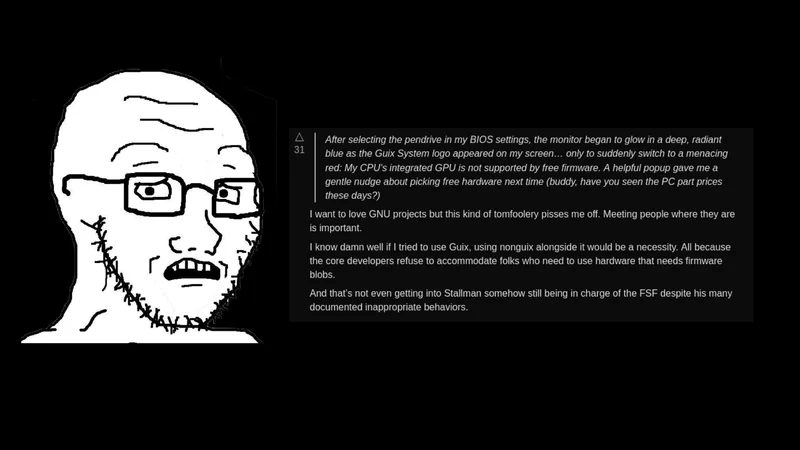
Let's say that the Free Software Foundation were to 'accommodate' these people by including Non-Free software by default, this would mean that they would have to bend their principles of Free software in their own OS and in their view, do something potentially unethical. Who cares what they think is unethical, the important thing is that they are being pressured to forget all about their principles to appease these people.
Despite losing popularity and pragmatism, if the FSF has to keep eroding their principles by 'meeting people where they are', eventually there will be nothing left of the original idea. This is called a slippery slope for a reason. People will keep asking you to make it more accessible until either your program bloats to gigabytes in size or your idea becomes so watered down, it will won't make any meaningful change. This is why its important to firmly lay down your principles and let others come to you instead of appealing to the masses. This is how you make real world change.
This attitude comes off as elitist because it is different than the status quo and therefore causes friction with what people are used to right now. Elitism will ensure that you don't become like the status quo you are trying to change, and that's why its very important to be this way.
Most people have no idea what Free software even stands for and why, and this is why the FSF created their organization in an explicitly elitist way. On their website, one of the first pages you will see is: Anchoring The FSF in its Values
They realized that lots of people who would benefit from their work, but disagree with Software Freedom, could join the organization and VOOT the original people out and replace them with new soys who don't uphold software Freedom values. Therefore, they created a board of directors who were the only people who could vote on electing new members for certain legal reasons (they couldn't just have a board of directors with NO democracy). This would prevent other organized groups from paying a bunch of people to VOOT for their own ideas effectively taking over the FSF. I think it's It is further proof that even after 40 years, the FSF is still maintaining those same core Freedoms as the very beginning.
The conclusion we can take away from the FSF and its goverance, is that it is important to hold strong to your principles to make meaninful change, even if the status quo or alternatives are more pragmatic or popular.
This is important for the software world as a whole because governments and companies want to keep you locked into their systems and force you to pay them with your money, privacy and freedom. This is why Free software that lets you use, change and distribute software as you please, and it's is very essential to your digital sovereignty. Without the FSF, we'd be even more locked into proprietary and Non-Free ecosystems and wouldn't be able to have the freedom to use computers in the way that we take for granted right now.